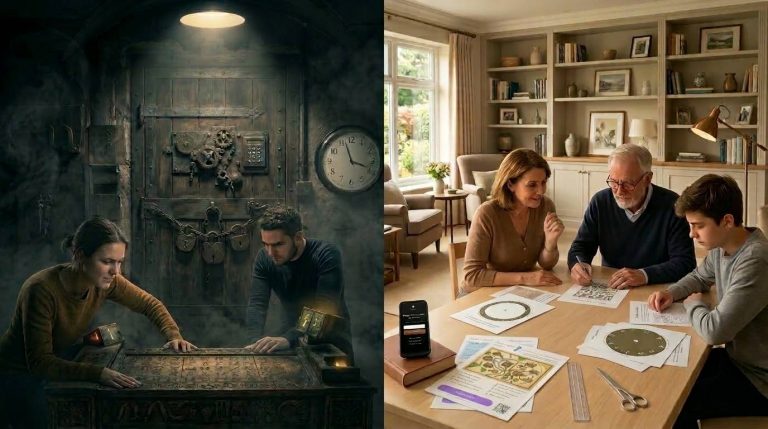

If you’ve ever wanted the thrill of an escape room without the hassle of booking tickets, driving across town, or squeezing ten people into a timed reservation — a printable escape room might be exactly what you’ve been looking for.
Whether you’re planning a game night, a classroom activity, a birthday party, or just a fun weekend at home, printable escape rooms deliver all the puzzle-solving excitement of the real thing, right from your own printer.
The Short Answer
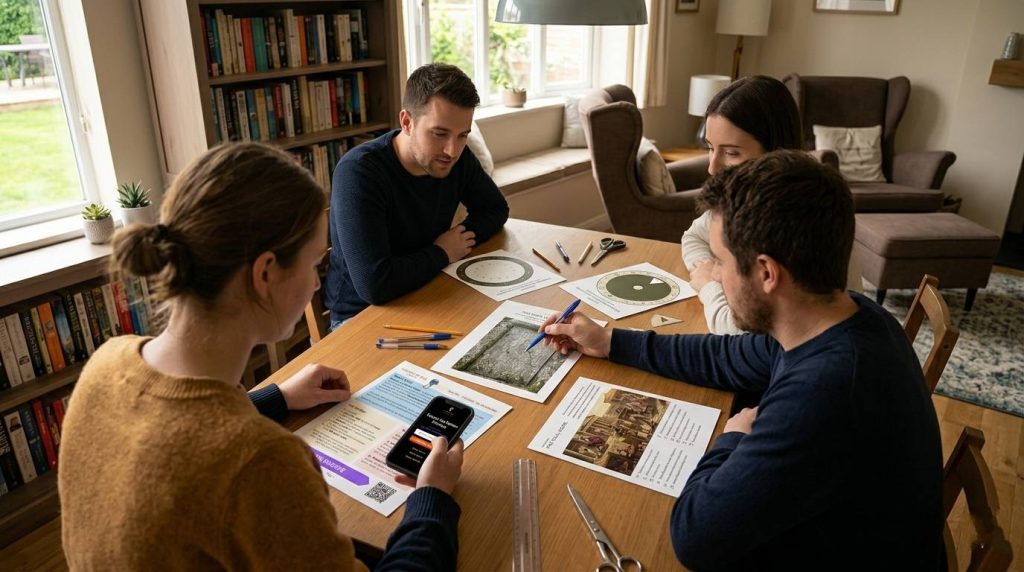
A printable escape room is a downloadable game you purchase online, print at home, and play at your own table. It comes with a set of puzzles — codes to crack, clues to decode, riddles to solve — that players work through together to “escape” before time runs out. Take our game Escape the Roman Fortress, for example: players work through seven trials, each one guarding a four-digit code that unlocks the next chamber. Solve all seven, and you earn your freedom.
No special venue. No reservations. No age minimums. Just paper, a printer, and a group of people ready to think.
How Did Printable Escape Rooms Come About?
Traditional escape rooms exploded in popularity through the 2010s, but they came with real limitations: they were expensive, required advance booking, had strict capacity limits, and weren’t always accessible for families with young kids or groups with mobility needs.
Printable escape rooms filled that gap. As PDF games and downloadable party kits became mainstream, designers began creating escape room experiences you could run entirely on paper — and the format took off. Today, you can find printable escape rooms for kids, adults, classrooms, corporate teams, bachelorette parties, and everything in between.
What’s Actually Inside a Printable Escape Room?
Most printable escape rooms come as a PDF download. Escape the Roman Fortress, for instance, is an 11-page game that contains everything your group needs:
Puzzle pages — The core of the game. Each of the seven trials occupies one to two dedicated pages, meaning all clues needed to escape each chamber are self-contained. Puzzle types range from observation and pattern recognition to cipher-cracking and logical deduction — no two rooms feel the same.
Story & scenario — A narrative framing that sets the stakes. In Escape the Roman Fortress, you’ve wandered into a sealed wing of a Roman fortress. A massive stone door slams shut behind you, trapping you within seven sacred rooms once used to test Rome’s greatest minds. The pressure is real.
A dedicated game website — Rather than a printed answer key, players enter their four-digit codes on a game-specific website to check their answers and advance to the next trial. The site also offers hints for groups who get stuck, so you’re never completely stranded.
Cut-out components — Some puzzles include physical elements players interact with, like a rotatable cipher wheel that gets cut out and assembled as part of the Trial of Order.
How Does a Printable Escape Room Actually Work?
Here’s what a typical session of Escape the Roman Fortress looks like, step by step:
1. Download and print. After purchasing, you download the PDF and print all pages single-sided — a color printer is recommended to get the full visual impact of the artwork and puzzles.
2. Gather your supplies. Unlike some games, Escape the Roman Fortress does require a few simple household items: a ruler (for drawing straight lines), scissors (for cutting out certain puzzle components), a pen or pencil for marking up pages, and a smartphone to access the game website.
3. Brief the players. Read the opening scenario aloud — you’ve entered a sealed Roman fortress and must prove your worth to escape — and explain the core rule: solve each trial, find the four-digit code, and unlock the next chamber.
4. Players start puzzling. From here, the group works through the game page by page, in order. Each trial is self-contained, so all the clues you need are right in front of you. Good communication and sharp observation are usually the difference between breaking the seal and getting stumped.
5. Check your codes. Whenever players think they’ve cracked a trial, they enter their four-digit answer on the game’s dedicated website to verify. Right answer? Move on to the next chamber. Stuck? The site offers hints to nudge you back on track without giving everything away.
6. The big finish. Conquer all seven trials — Observation, Authenticity, Order, Intellect, Discipline, Deduction, and Power — and you’ve broken every seal and earned your freedom from the fortress.
What Makes Escape the Roman Fortress Stand Out?
A cohesive theme done right. The Roman Empire setting isn’t just window dressing — it shapes every puzzle. You’ll decode military dispatches the way Roman commanders did, sort citizens by rank according to the rules of the Empire, and spot anachronisms among those who claim to belong to Rome.
Seven genuinely different puzzles. With seven trials each using a distinct puzzle mechanic, there’s no repetition. Each room tests a different skill — pattern recognition, visual attention, logical ordering, cipher decryption, and more.
Beautifully designed pages. The artwork is rich and immersive. Even before a single puzzle is solved, the pages feel like artifacts from another world.
Flexible group size. The game scales naturally depending on how many people are playing. For 1–4 players, you work through it page by page. With 5 or more, you can cut out clues and spread them across a table for a more physical, chaotic experience. Got 6 or more? Split into competing teams, each with their own copy, and race to escape first.
Mark it up freely. Since the game is designed to be played once, players are encouraged to write, draw, and annotate directly on the pages — no need to be precious about it.
Who Is Escape the Roman Fortress For?
The game is rated for ages 12 and up, and most groups will take 60–90 minutes to complete it. That makes it a perfect fit for:
- Family game nights with older kids and teenagers
- Friend groups looking for something more engaging than a board game
- Date nights at home — two players is plenty
- Classroom activities for history classes or critical thinking exercises
- Parties and events where you want an activity that gets everyone talking
Printable vs. In-Person Escape Rooms: What’s the Difference?
| Printable Escape Room | In-Person Escape Room | |
|---|---|---|
| Cost | Fraction of the price | $25–$40+ per person |
| Location | Anywhere | Fixed venue |
| Group size | Flexible | Capacity limited |
| Scheduling | Play anytime | Book in advance |
| Setup | 10–15 min | Done for you |
| Immersion | High (beautifully designed pages) | Very high (physical room) |
| Replay | Print again for a new group | Rarely replayable |
Neither is “better” — they’re different experiences. A professional escape room delivers physical immersion and theatrical production that paper can’t replicate. But a printable escape room offers flexibility, affordability, and intimacy that a booked time slot never will.
Ready to Prove Your Worth to the Empire?
Escape the Roman Fortress is one of the most satisfying ways to bring people together around a shared challenge — no screens, no apps, just ancient puzzles and a race against the seal.